发表期刊:Sustainable Cities and Society
分区:SCI一区
影响因子:12.0
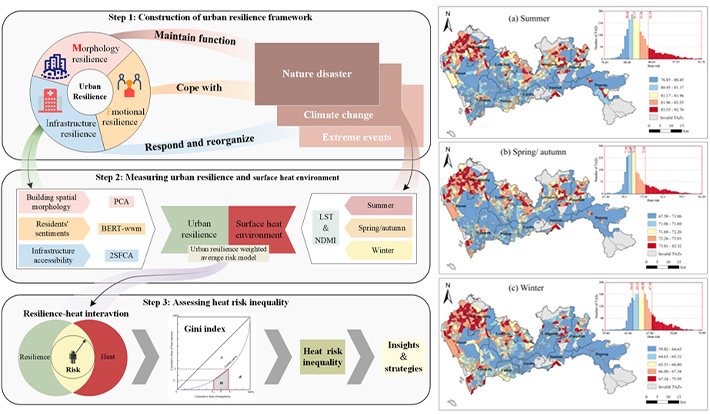
Climate change and rapid urbanization have transformed the urban surface thermal environment, with consequent burgeoning social inequalities in terms of heat risk. Given the important role of urban resilience in adaptation and resistance to various shocks and disasters, examining heat risk from the perspective of urban resilience is critical to accurately assess and manage risk. Hence, we propose an urban resilience assessment framework based on emotional, morphology, and infrastructure resilience, and explore heat risk and its inequalities at the neighborhood scale by incorporating surface thermal conditions. The empirical results with Shenzhen, China, as a case study indicate that urban resilience exhibits spatial heterogeneity, with most areas at a medium resilience, and some clustering of high resilience areas. Moreover, 16.25 % of neighborhoods are at very high heat risk in all seasons, primarily in the northwestern part of the city. In contrast, urban central areas are mainly under medium and low risk, with their heat risk often being overestimated. Furthermore, seasonal differences in heat risk inequality are minimal, while areas with industrial and transportation functions tend to exhibit higher inequality. The underlying cause is a significant mismatch between urban resilience and thermal condition, where the impact of resilience further exacerbates the inequality of heat risk. This study provides evidence and insights into the application of urban resilience in sustainable city building at a fine scale.