发表期刊:LAND
分区:SCI三区
影响因子:3.5
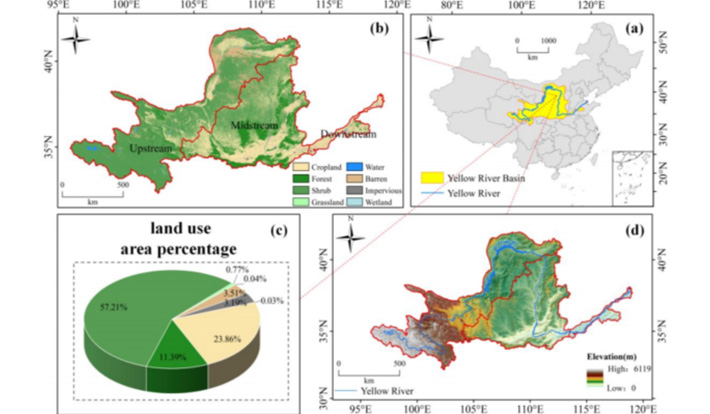
Net primary productivity (NPP) is a key indicator of the carbon sequestration capacity of terrestrial ecosystems, and its dynamics are jointly influenced by climate change and human activities. However, quantitatively disentangling their respective contributions and clarifying their non-linear interactions remains challenging. In this study, remote sensing, meteorological, and anthropogenic data were integrated to investigate the spatiotemporal dynamics of vegetation NPP in the Yellow River Basin (YRB) from 2000 to 2024. Six scenarios were constructed to quantify the relative contributions of climate change and human activities. Furthermore, an XGBoost-SHAP framework was employed to elucidate the underlying non-linear driving mechanisms. The results indicate that vegetation NPP exhibited a significant increasing trend over the study period, with a rapid recovery phase after 2012 and a peak in 2024 (351.75 gC & centerdot;m(-2)& centerdot;a(-1)), representing a 71.43% increase compared with the baseline period. Spatially, the upper reaches were primarily climate-driven (58.74%), the middle reaches showed a strong synergistic effect between climate and human factors (97.41%), while the lower reaches were dominated by human activities (73.02%). The XGBoost-SHAP analysis identifies land surface temperature (LST) as the primary moderator of carbon sequestration across river basins (mean SHAP > 12.0). The driving mechanisms exhibit a clear longitudinal shift, transitioning from a heat-dominated regime in the upper reaches to a complex interplay of precipitation and intense urbanization in the middle and lower reaches. These non-linear interactions reveal critical feedback loops between natural hydrological constraints and urban expansion pressures. These findings clarify the drivers of regional carbon sequestration, providing a scientific basis for targeted ecological management and carbon neutrality strategies in the YRB.