发表期刊:Building and Environment
分区:SCI一区
影响因子:7.1
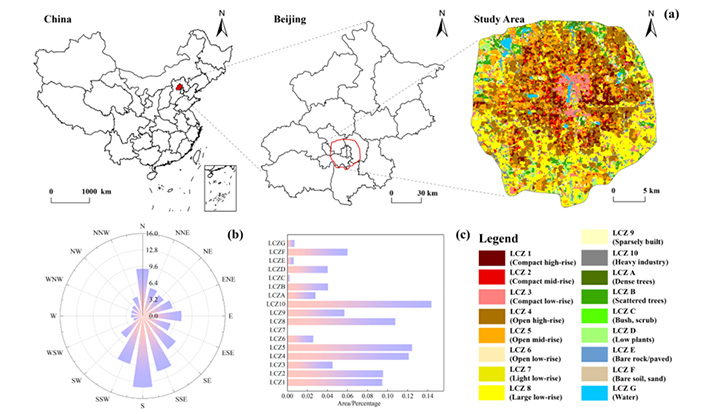
The construction of an urban cooling network is regarded as a strategy with significant potential for effectively mitigating the urban heat island (UHI) effect. UHIs are influenced by multi-dimensional urban factors, and their impacts vary across different local climate zones (LCZs). However, current studies on the urban cooling network primarily focus on two-dimensional (2D) urban factors, neglecting the effectiveness of three-dimensional (3D) urban factors in mitigating the UHI effect. In this study, we propose a new model that integrates multidimensional factors influencing UHIs and incorporates LCZ to construct urban cooling corridors (UCCs) based on circuit theory, and classify the UCCs through wind directions and connectivity. Application of the model in the Beijing metropolitan area shows that 3D factors demonstrate a significant advantage over 2D factors in enhancing cooling efficiency, with cooling efficiency rates reaching 53.20 % and 46.80 % respectively. The 78 UCCs constructed within the Beijing metropolitan area exhibit significant cooling effects. For instance, areas within 0.05 km of the UCCs demonstrate the lowest land surface temperature (LST), which is 1.92 °C lower than that at 2 km and 1.85 °C lower than that at 3 km. The UCCs identified by our model effectively mitigate the UHI effect, thereby enhancing urban livability.