发表期刊:Sustainability
分区:SCI三区
影响因子:3.3
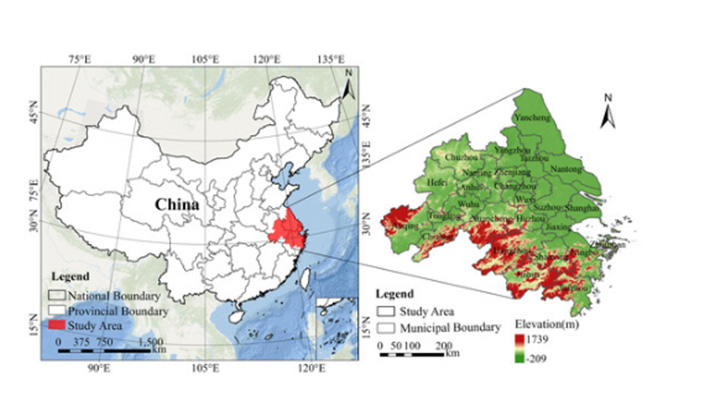
Accurate analysis of land use transformation (LUT) and its ecological and environmental effects, along with investigations into how ecological and environmental quality responds to both natural and human factors, is crucial for protecting regional ecosystems. This research concentrated on the Yangtze River Delta Urban Agglomeration (YRDUA), analyzing land use change patterns and their effects on ecological environment quality (EEQ) from the perspectives of production, living, and ecological spaces. Partial least squares structural equation modeling (PLS-SEM) was utilized to assess the immediate and mediated effects of environmental and socio-economic drivers. Additionally, this study examined how urban agglomeration integration affects LUT and EEQ. The findings suggest that: (1) Throughout 2000-2020, production land decreased, and living land expanded markedly, while ecological land remained largely stable. (2) Between 2000 and 2020, the overall environmental quality in the YRDUA declined, showing significant temporal and spatial disparities among regions. (3) Converting urban or rural residential land to agricultural land promotes ecological improvement, whereas the opposite conversion tends to result in environmental degradation. (4) Topography, climate, and greening directly improve environmental quality, whereas LUT, economic development and integration exert adverse impacts. Topography indirectly influences the ecological environment through its effects on climate, economy, regional integration, and LUT, whereas climate and the economy exert indirect effects via LUT, greening and integration. This research serves as a scientific foundation for ecological environment protection, sustainable growth and regional land space planning in urban agglomerations.